
- Home
- /
- The DxRI Dispatch
- /
- Interviews
- /
- Shining a Light on...
Shining a Light on Night Light Neon with Nick McKnight
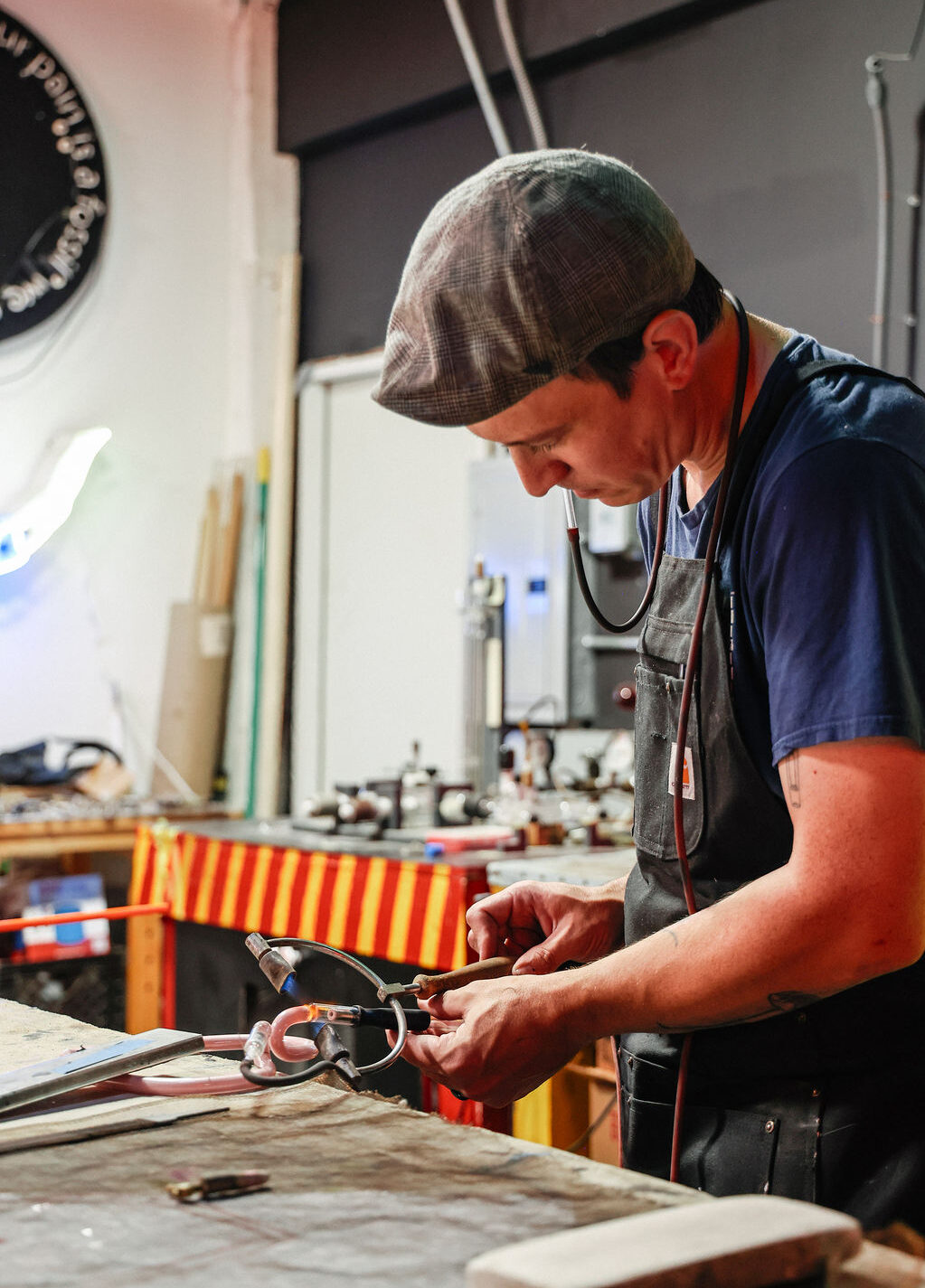
Photo by Rue Sakayama
We’re shining a light, literally, on Nick McKnight, owner of Night Light Neon in Providence and a 2024 alum of the Design Catalyst Program. Nick has dedicated his career to keeping the craft of neon alive, transforming this historic medium into contemporary art, signage, and experiential lighting for interior spaces. In our full interview, Nick takes us behind the scenes of his studio, shares his philosophy on sustainable and repairable design, and reflects on the evolution of neon as both a craft and an art form.
From collaborations with interior designers and restaurants to a rental library serving film and television productions, Nick’s work highlights the versatility and enduring appeal of neon. He also shares his role in founding the Neon Makers Guild, a community connecting experienced neon artists with the next generation of makers, and previews an upcoming six-month exhibition at the Fuller Craft Museum.
Read on to explore how Nick combines creativity, craftsmanship, and history to push the boundaries of neon, keeping it relevant and vibrant for years to come.
+++
DxRI : Can you tell us a bit about your background? You started as a printmaker before launching Night Light Neon, what drew you to neon as a medium, and what continues to keep you engaged in the work?
Nick McKnight : I think, like a lot of people, I was immediately drawn to neon, it’s kind of a moth-to-a-flame experience. For a long time, though, it felt like a pretty closed-off craft. You didn’t really see how it was made or what was happening behind the scenes. Once platforms like YouTube started opening that up, I began seeing artists and fabricators actually bending glass, and something just clicked. I remember thinking, that’s what I want to do.
What really hooked me was the tactile nature of the process. You’re physically shaping material, working with your hands, and engaging with each step along the way. And then at the end, you bring it to life and it lights up. That moment never gets old. It’s incredibly satisfying.
What keeps me engaged is that no two projects are ever the same. Each one is a puzzle. Sometimes they’re more straightforward, but often clients bring something new to the table, or I’m exploring new ideas in my own work. Even when I’m revisiting a form or producing variations of the same piece, there’s always room to experiment, through color, scale, or small changes that make each piece feel unique.
DxRI : There’s almost a printmaking quality to that approach. It brings to mind artists like Andy Warhol, where the same image can take on new meaning through shifts in color or variation. Do you think about your neon work in a similar way?
NM : Yeah, definitely. I’ve actually made editions of certain pieces, like “(birds chirping)” design as an edition of three. And I’ve had people push back on that, saying you can’t edition glass. But I don’t really subscribe to that. You can approach it however you want.
For me, it’s about the freedom to explore the work in different ways. You can create one-of-a-kind pieces, or you can revisit a form and experiment through color, variation, or subtle changes. That flexibility is part of what makes it exciting.
At the end of the day, the boundaries are pretty open. You see all kinds of ideas out in the world, some unexpected, some unconventional, and it reinforces that there’s room to define your own approach. Whether it’s an edition or a one-off, it’s really about what feels right for the work.
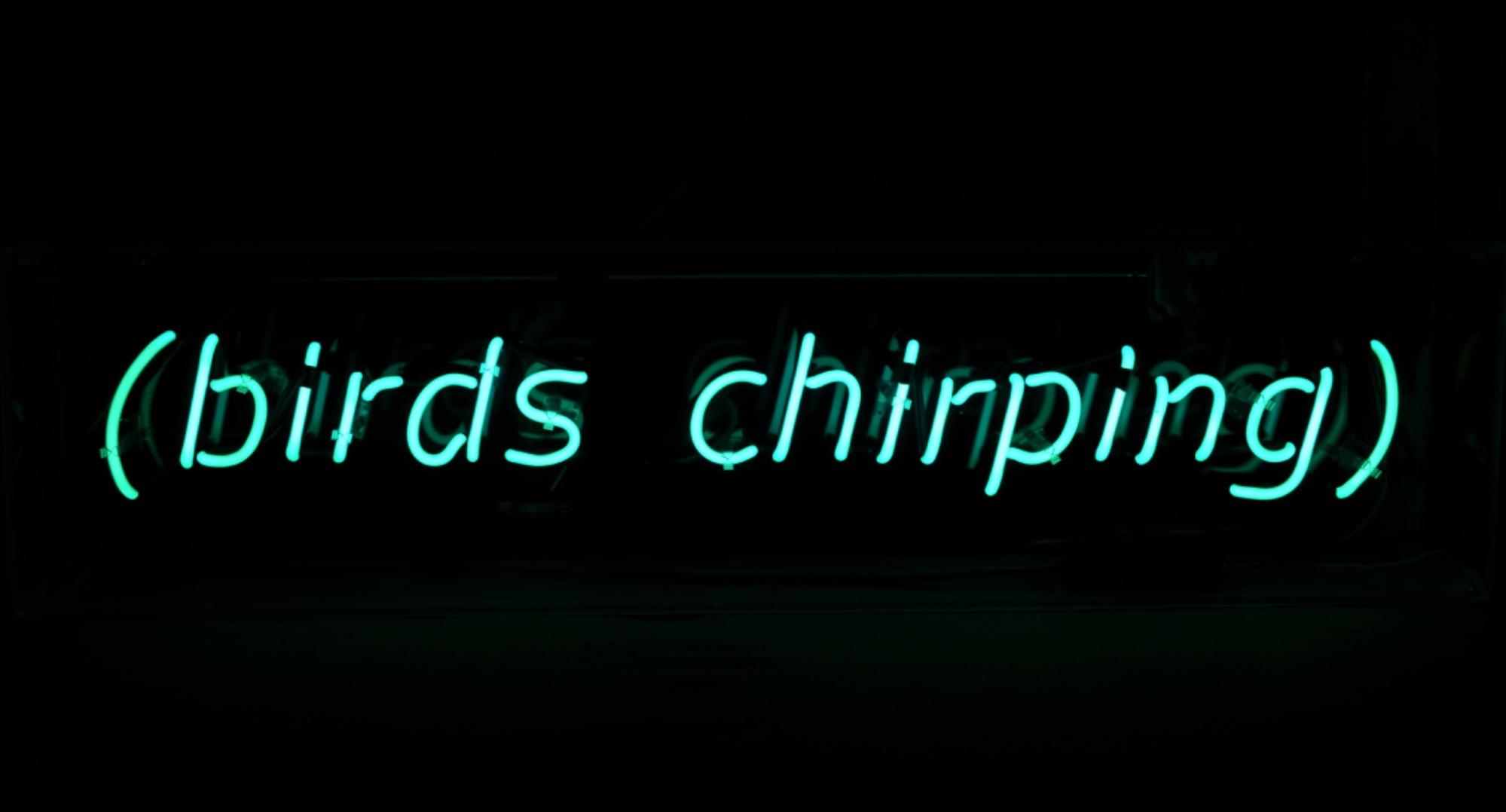
Photo Courtesy of Nick McKnight
DxRI : So in a way, the idea of creating editions isn’t new to the medium, it’s just being applied differently. Instead of reproducing a logo for five storefronts, it might be an artwork like “(birds chirping),” explored across a small series. It’s essentially the same principle, just shifted away from commercial use and toward creative expression.
What’s your favorite kind of client project to take on?
NM : The opportunity to be involved in the design process. That’s a big part of what draws me to the work. That said, there’s also something really satisfying about more straightforward projects, where a client comes in with a clear design and I can focus on fabricating it well and getting it out the door.
What’s interesting is how much regional context shapes that work. If you look at places like Austin, or cities on the West Coast like Los Angeles or Seattle, signage tends to be much more expressive and experimental. There’s a willingness to take creative risks and push the visual language further.
In New England, it’s traditionally been a bit more reserved. You see a lot of box signs, vinyl lettering, and more conventional approaches. But that’s starting to shift, especially in Providence and even more so in Boston. There’s a growing openness to signage that feels more custom, more artistic, and more reflective of a brand’s personality.
DxRI : I noticed your chandeliers, which are really striking. It got me thinking about the long history of neon and the process behind it. Where do you see neon going in the future? How do you think this craft will evolve?
NM : One of the things I find fascinating about neon is how unique it is. You have the opportunity to make something completely custom for a client, and that creative freedom is rare. At the same time, we live in a world where people are increasingly concerned about energy use and sustainability. Neon is beautiful, but it also has a resource footprint, so there’s a tension there.
For me, the challenge and the excitement are figuring out how to keep neon relevant and vibrant without compromising on aesthetics or craftsmanship. It’s about preserving the artistry while thinking critically about the future of the medium. Every project is a chance to explore that balance, and that’s what keeps me engaged and inspired.
DxRI : Based on what you’ve seen in the industry since launching your business, what do you think the future of the neon industry looks like?
NM : Well, to understand the future, you have to look at the history. Think about Tokyo, Times Square, or even older lighting like cold cathode inside casinos and hotels, these all came from the same tradition. Places like Foxwoods and Mohegan Sun had entire buildings lined with neon or cold cathode, and you saw that all over New York, Colorado, California.
But starting in the mid-2000s, a lot of that disappeared. Maintenance is a challenge. Neon lasts a long time, but if one tube fails, you need a crane, specialized labor, and ongoing care. Over decades, it became impractical, so many large-scale installations were removed. That era of massive street or building-scale neon is largely over.
To keep neon signage alive, there has to be patrons of it. I think the future is in smaller-scale, custom work. Patrons of the craft, art installations, chandeliers, and bespoke lighting for restaurants, bars, and businesses are where neon will thrive. It’s about creating intimate, meaningful experiences rather than large, commercial spectacles. That’s where the medium still has life, and where the creativity really shines.
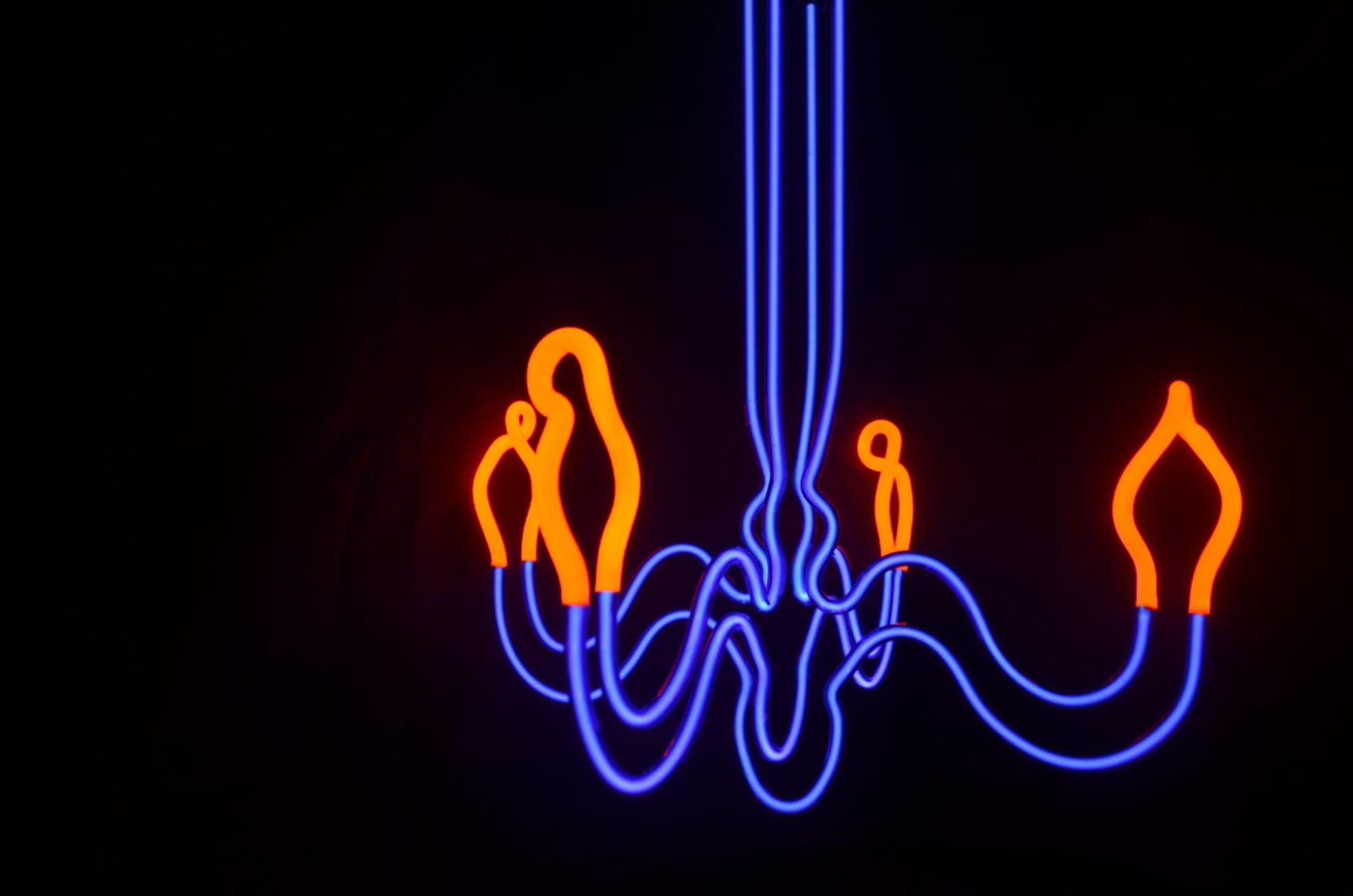
Photo Courtesy of Nick McKnight
DxRI : I love what you said earlier about neon needing patrons to survive. We can all appreciate it – if nobody’s supporting it, it simply won’t exist. So who are your patrons?
NM : A lot of my work comes from a variety of sources. I do repairs for other signage companies, and sometimes even other neon shops. Then there are bars and restaurants, collectors of signage and art, and individuals with heirloom pieces from their families. One of my favorite groups to work with is architects and interior designers. That’s where you really get to see neon integrated thoughtfully into a space, whether it’s a restaurant, bar, or a private home. Designers bring a vision that allows the medium to shine in ways people might not have imagined.
It’s tricky, because a lot of people don’t know what they want until they see it. When I create a piece and show it, that’s when they realize, “Oh, that’s exactly what I need.” It’s about sparking ideas and helping designers translate that into interior spaces. Occasionally, the film industry calls too, for rentals or custom work when they’re in town. But the interior design projects are where I really see neon’s potential to transform a space and create something experiential.
DxRI : Can you tell me a little more about your rental library? I was on your website and thought it was fascinating that you have all these signs available for film, TV, and other projects. How did that come about?
NM: A lot of the bigger neon shops across the country do something similar. They maintain collections of generic neon pieces that they rent out for productions. With film, everything has to be period appropriate, down to the smallest detail. Costumes, props, and signage all matter. You can’t just use fake neon. If a scene is set in 1967, the typography, colors, and styles all have to match that era. Sometimes the signs exist already on location, but often, they’re custom installed for the shoot. That’s where rentals like ours come in.
DxRI : What about your rentable pieces? Do you have favorites or popular items?
NM : It really varies. Every production has different needs. Movies will call and say, “Do you have an ice cream cone?” And sometimes I don’t, but I can always make one. We have a tiered system for rentals: standard pieces have one price, fully custom builds another, and there’s a middle option for custom rentals at a reduced rate, as long as we get the piece back afterward. It gives a lot of flexibility for productions.
DxRI : And sometimes, you make something for a scene that ends up getting cut.
NM : Yeah, that happens all the time. It’s part of the process, and that’s fine. The goal is to give filmmakers exactly what they need, even if it’s just for a few seconds on screen.
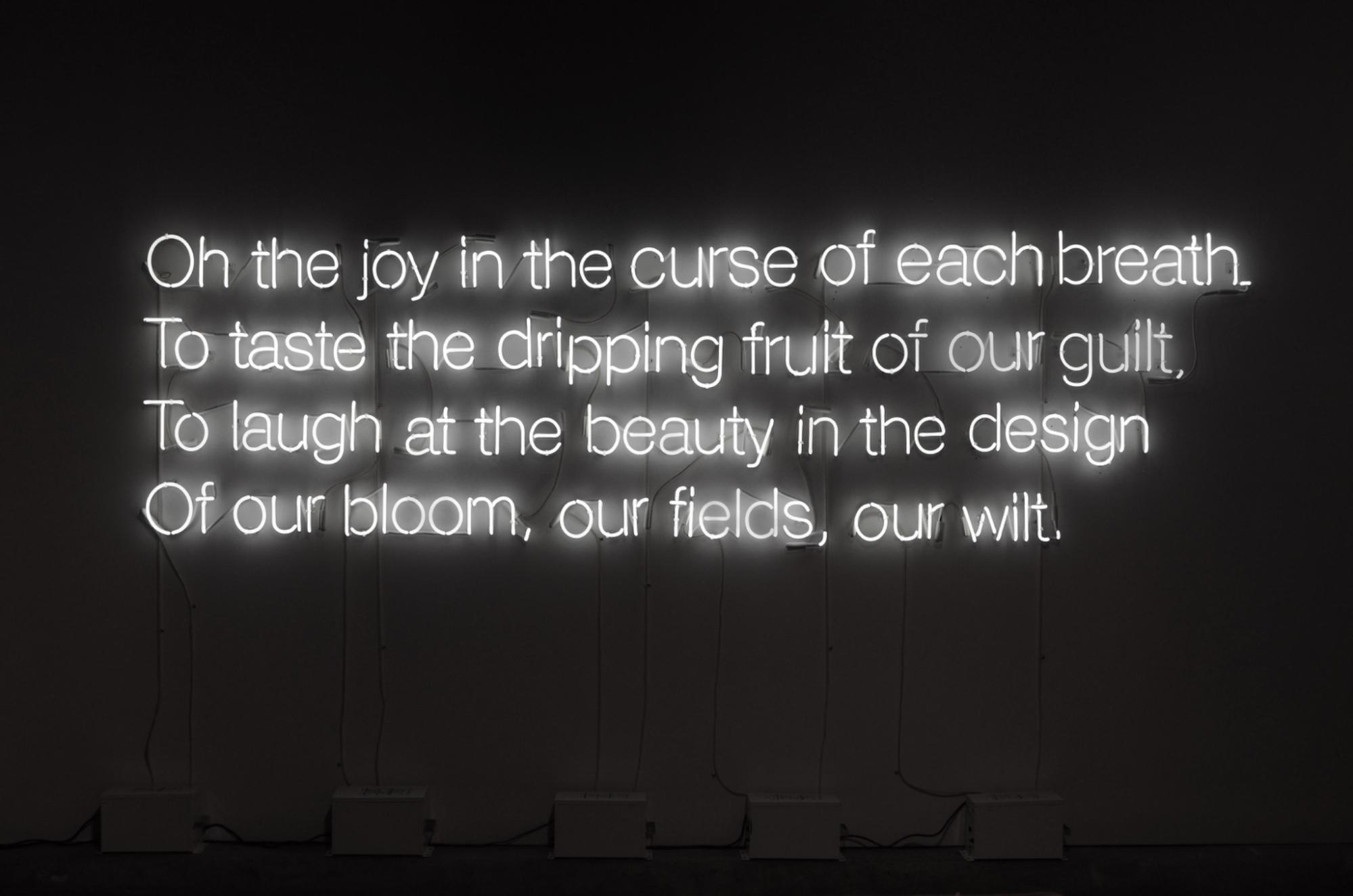
Photo Courtesy of Nick McKnight
DxRI : Okay, so we were talking about neon being on the periphery of the glass field.
NM : Yeah, it has always been primarily signage. Back in the day, the very first commercial neon sign in California was for a Packard dealership. From there, it just spread like wildfire. Every business wanted a neon sign. It was gorgeous. I wish I could have seen it firsthand. But historically, neon was pigeonholed as strictly utilitarian – a sign for a business.
For a long time, the glass community didn’t really recognize neon as an artistic medium. That has started to change in the past 40 or 50 years. Contemporary artists like Bruce Nauman and Keith Sonnier began bringing neon into museums, which helped shift its perception. It’s still largely signage, but it’s slowly being recognized as a craft and artistic medium.
Neon can exist in both spaces, it’s versatile. It can be functional and utilitarian, or it can live in the realm of fine art. Sometimes it even does both at once, like in pop art, where it’s bold, playful, and visually striking while still being a crafted object.
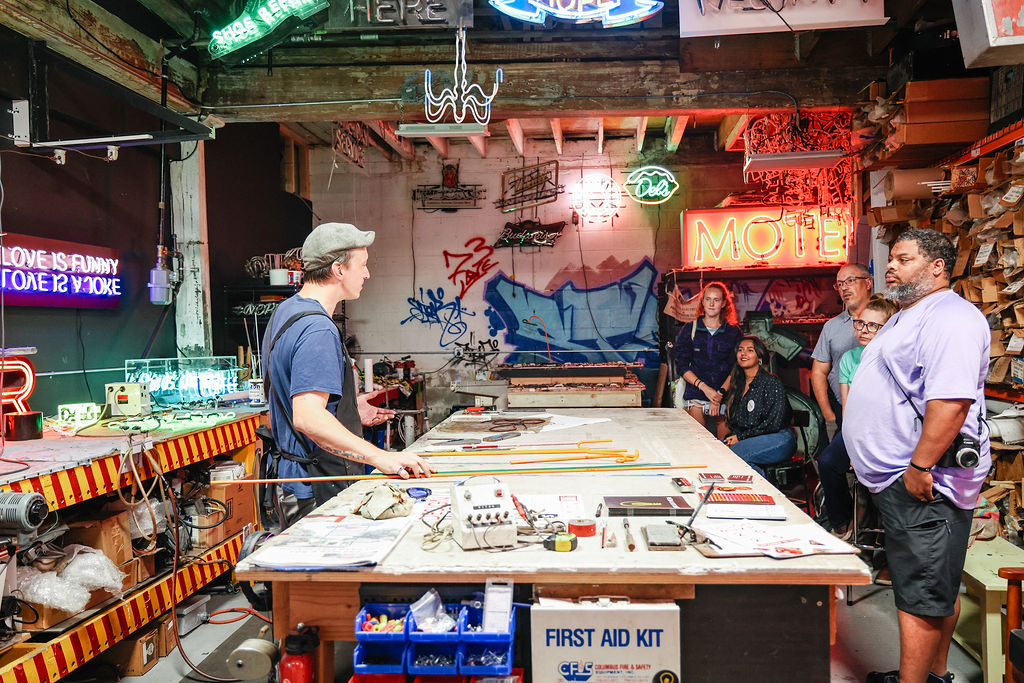
Photo by Rue Sakayama
DxRI : And you’ll be curating a neon exhibition at the Fuller Craft Museum. Can you tell me more about that.
NM : A few members of the Neon Makers Guild and I reached out to the Fuller Craft Museum years ago with the idea, and as with many museums and art shows, it took time to come together. They have always wanted to feature neon, because it fits naturally within the craft world. Neon has historically existed on the periphery, so part of this exhibition is about positioning it as a legitimate and valued craft.
A key motivation for the exhibition ties back to patronage and preserving the medium. A few benders and I started the Neon Makers Guild to connect experienced neon artists, many of whom are retiring or passing on their knowledge, with young people who want to learn the craft. The guild now has about 70 members, primarily in the U.S. The exhibition will feature work from guild members and is scheduled to run for six months, from late 2028 into 2029. It’s an exciting opportunity to showcase neon’s artistry and craftsmanship on a larger stage.
DxRI : So you’re also one of the founders of the Neon Makers Guild. Where are the members from? Is it a local guild?
NM : Not really. We have members all over. For example, my old coworker Tony is part of Neon Williams in Somerville, Massachusetts. Some of the older generation, many of whom are retiring or have passed, are from places like New Hampshire and Maine. There’s someone called Neon Dave in Portland, Maine, who may still be part of the guild.
While we initially thought about a regional New England show, there aren’t quite enough of us locally to do that, so most members are fine with shipping their work to participate. There’s a strong presence from New York City, Seattle, and even North Carolina. It’s really exciting to see this community spread across the country.
The guild itself is growing. We organize regional meetups, like at the Cincinnati Neon Museum and others out west, where members can share knowledge, do demonstrations, and nerd out over the craft. Hopefully, we’ll be able to host something like that when the exhibition happens here. It’s a really inspiring community, and it’s amazing to be a part of it.
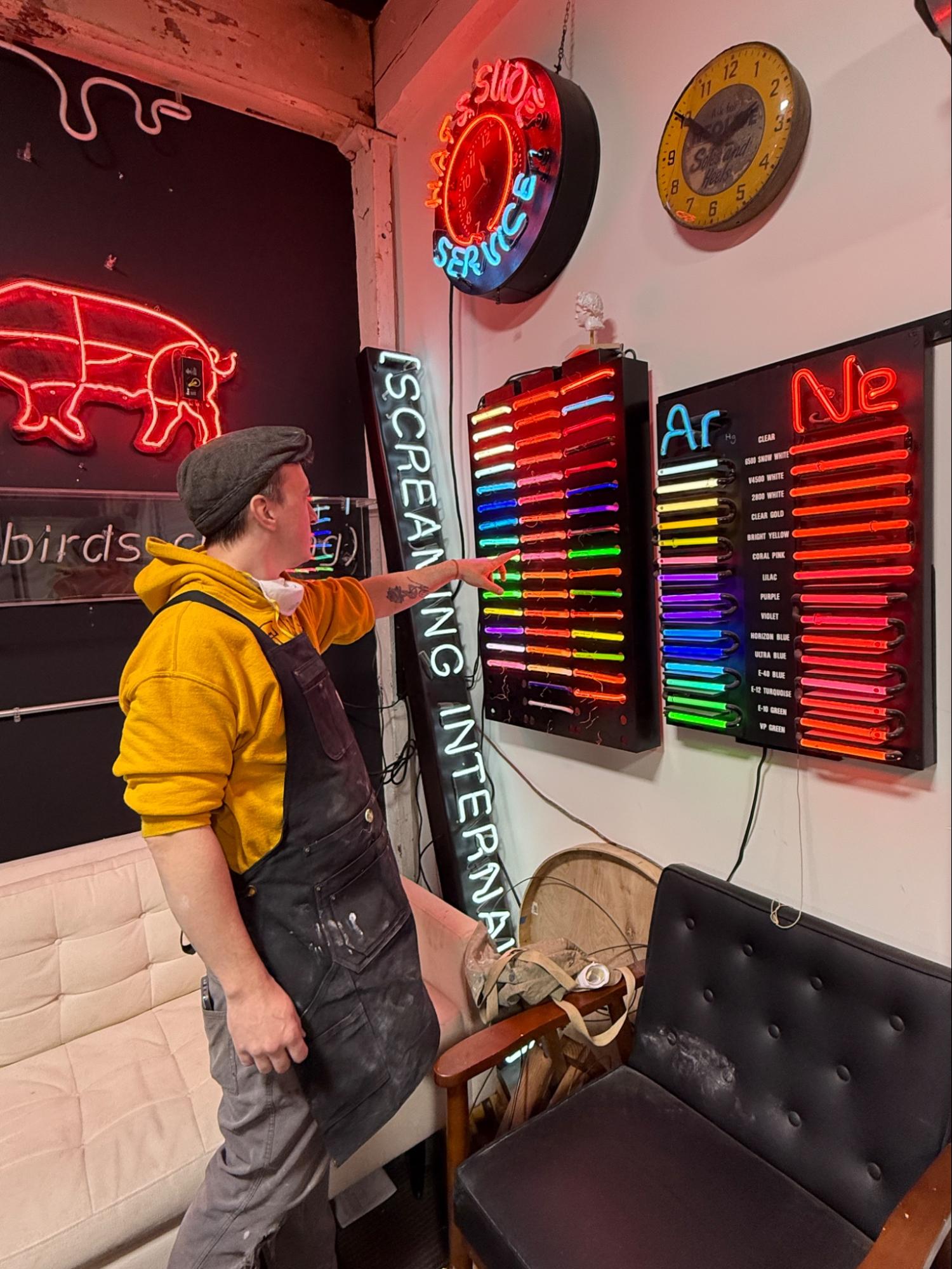
Photo Courtesy of Nick McKnight
DxRI : I recognize that there aren’t many members of the Neon Makers Guild who are local to you, and it really highlights how unique your work is. How many neon shops are there in Rhode Island?
NM : In Rhode Island, there’s really only one dedicated neon shop – that’s me. There are a few others in the area that do related work… But, Night LIght Neon is the only shop fully dedicated to neon design and fabrication.
DxRI : So you’re essentially the one shop in Rhode Island entirely focused on neon.
NM: Exactly. That’s right.
DxRI : Are there any local projects you’ve worked on recently that you’re excited about?
NM : Yeah, there are a few. One that comes to mind is the Wienorama Restoration in Cranston. That was lit up last year and was a lot of fun to work on. Another big one was for the Rhode Island State Police Museum. I redid their large emblem, it’s a six-foot-tall badge that now lives in the museum. They were celebrating a major anniversary, so I transported it and installed it on-site. It was almost forensic work, because this badge was the last of about eight that used to exist in Rhode Island. The others had been discarded over the years. I had to figure out where the lettering went, hand-paint the entire piece, bend all the glass, and wire it. There’s a lot of detail and problem-solving involved, which made it really rewarding.
DxRI : Anything currently in the works that people might be able to see later?
NM : One that I can talk about is a collaboration with Providence Painted Signs on the Atlantic Mills Building sign. We’re redoing the sign, keeping the same design, but we’re taking the faces off and creating an outlined version. Providence Painted Signs is painting the background, and we’ll handle the neon. It’s a mix of hand-painted signage and neon, and it’s a big project with a lot of moving parts.
DxRI : You mentioned LED earlier, and it got me thinking. On your website, you emphasize quality over quantity and creating durable, sustainable products in a world full of disposable goods. How does that philosophy influence the way you design and fabricate? How does it live in your process?
NM : That’s a great question. With neon, the medium itself is inherently repairable. You can cut off a piece of glass and add a new one while keeping the essence of the original. That also comes into play with conservation, especially for museum-quality pieces. There have been ongoing conversations with institutions like the Getty Museum about how to preserve neon and stay true to its history. It’s about using authentic materials and maintaining the integrity of the original work. Some elements can’t be replaced, but most of it can. Glass itself is organic, and I really value that aspect.
LEDs, on the other hand, are entirely different. They’re plastic, contain chemicals, and aren’t repairable. When they fail, they go straight to the landfill. That’s the planned obsolescence of so many products. I don’t want that. When I make something, I want it to last, to be enjoyed for years, and to create a nostalgic or emotional connection. Neon tells a story rather than just sending a message.
DxRI : It sounds like there’s a real difference between mass-produced signage and something handcrafted.
NM : Exactly. When a client comes to me, they’re looking for a human to design and fabricate their vision, not just a product off a catalog with a planned expiration date. With neon, even the pieces I repair become intergenerational artwork. I’m working with glass that was bent decades ago by another hand, and now I’m a part of its story, continuing its history into the future. That connection to history, to craft, and to the people who’ve engaged with the piece before, that’s what makes neon enduring and meaningful.
Photo by Rue Sakayama